
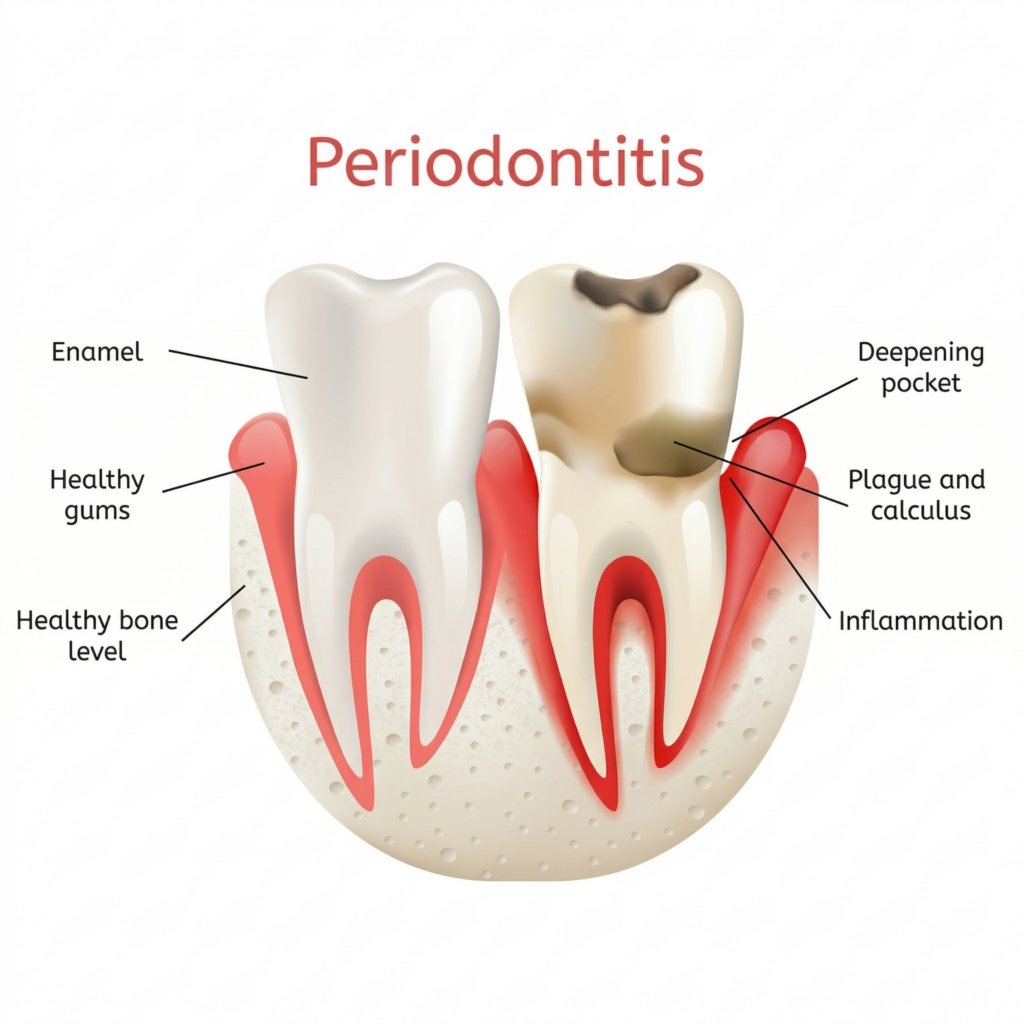
Periodontal disease is a bacterial infection of the tissues that support the teeth, and it is one of the most common conditions an Anchorage dentist treats. It ranges from mild gingivitis to advanced stages with bone loss and loose teeth. The inflammation does not stay confined to the mouth either, because ongoing bacterial spread and the body’s inflammatory response can affect other systems, which is why gum health belongs in long-term care of the whole body.
In Short: Periodontal disease is a progressive bacterial infection of the gums and supporting bone that can end in tooth loss if untreated. Bleeding gums and persistent bad breath are usually the earliest signals. Caught early, it is treatable with scaling and root planing and a tightened maintenance schedule.
What does healthy gum tissue look like?
Healthy gum tissue is firm, evenly pink, tightly sealed around each tooth, and does not bleed during brushing or flossing. Knowing that baseline is what makes early changes visible.
Appearance. Healthy gums are typically coral pink, though natural pigmentation varies. The color stays even, with no redness along the gumline.
Texture. The tissue feels firm and holds a defined edge around each tooth. That tight seal protects the bone underneath. A slightly stippled surface indicates strong, stable tissue.
Condition. Healthy gums do not bleed during brushing or flossing, and there is no swelling, tenderness, or puffiness. Inflammation is usually the earliest warning sign that something has changed.
What are the signs of periodontal disease?
The signs of periodontal disease are bleeding gums during brushing or flossing, red or swollen tissue, persistent bad breath, gum recession that makes teeth look longer, loose or shifting teeth, pain when chewing, and deepening pockets between the teeth and gums.
Periodontal disease often develops without pain, which is why it is frequently missed in its early stages. Each of these symptoms points to bacterial infection below the gumline, and without treatment the infection progresses from inflamed tissue to structural damage in the bone.
What are the stages of periodontal disease?
Periodontal disease progresses from reversible gingivitis through four stages of periodontitis, each with more bone loss and a higher level of care required.
| Stage | What’s Happening | What It Means |
| Gingivitis | Inflammation and bleeding from plaque buildup | Reversible with proper care |
| Stage I Periodontitis | Early bone loss and shallow pockets | Requires professional treatment |
| Stage II Periodontitis | Deeper pockets and increased bone loss | Ongoing periodontal maintenance needed |
| Stages III and IV | Severe bone loss and tooth instability | High risk of tooth loss, advanced care required |
Once periodontitis develops, the focus shifts from reversal to long-term management.
What causes periodontal disease?
Periodontal disease is caused by bacterial plaque that accumulates along the gumline and hardens into tartar if it is not removed. Contributing factors include poor oral hygiene, tobacco use, diabetes and other systemic conditions, family history, hormonal changes, dry mouth from medications, and teeth grinding. Each factor either increases bacterial buildup or weakens the body’s ability to respond to the infection.
When is a periodontist needed?
A periodontist is needed when gum disease has advanced to surgical treatment or significant bone loss. Earlier stages are treated at Emerald Peak Dental with scaling and root planing, a deep cleaning that removes plaque and tartar below the gumline and smooths the root surfaces so the gum can heal.
Dr. Cluff performs scaling and root planing in the office, and cases that need surgery or grafting are referred to a periodontist with the diagnostic work already done. Timing decides the outcome here. Addressing the infection before significant bone loss occurs is what keeps a tooth savable.
How do you maintain periodontal health?
Periodontal health is maintained with twice-daily brushing along the gumline, daily flossing, and professional cleanings on the schedule your gum measurements call for.
Brushing. Brush twice daily with a soft-bristled toothbrush, angled toward the gumline where plaque collects.
Flossing. Daily flossing removes bacteria and debris from between the teeth, where a brush cannot reach.
Professional care. Routine visits allow early detection of inflammation and removal of tartar buildup. Patients whose measurements call for it move into periodontal therapy and a shorter maintenance interval.
Additional support. An antibacterial mouthwash helps some patients, and avoiding tobacco removes one of the largest risk factors outright.
The Standard We Hold
Periodontal disease progresses quietly, so we measure rather than wait. Gum measurements at every exam catch changes while they are still reversible.
Call (907) 562-1686 or book online.