
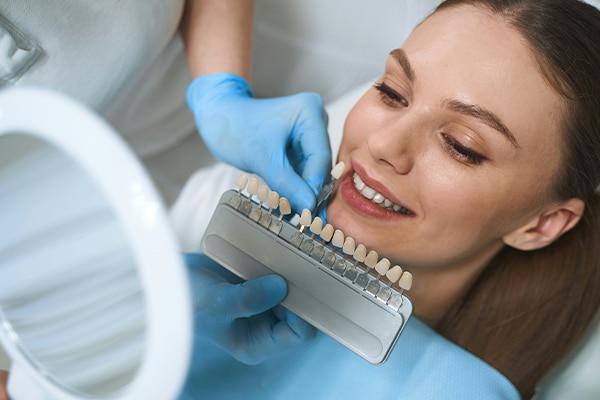
Teeth whitening vs veneers comes down to one question: is color the only thing you want to change? If yes, whitening is faster, cheaper and doesn’t alter your teeth. If you also want to fix chips, gaps, worn edges or teeth that are uneven, veneers do all of that at once, for a lot more money and for a lot longer.
Most people who ask us this in Anchorage want the first thing and assume they need the second. Here’s how the two compare, who each one suits, and what to expect from either.
Whitening vs veneers at a glance
| Teeth whitening | Porcelain veneers | |
|---|---|---|
| What it changes | Color only | Color, shape, size, small gaps, chips |
| Visits | One in-office visit, or a take-home kit | Two visits, about two weeks apart |
| Changes your teeth | No | Yes: a thin layer of enamel is removed |
| How long it lasts | 6 months to 2 years, then touch-ups | 10 to 15 years |
| Upfront cost | Low | High, per tooth |
| Ongoing cost | Touch-ups | Replacement after 10–15 years |
| Reversible | Yes; it fades | No |
| Sensitivity | Temporary, 24–48 hours | Some after placement, usually brief |
| Works on crowns and fillings | No | Covers the tooth, so yes |
When whitening is the right choice
Whitening is the right call when your teeth are healthy and shaped the way you want, and they’ve just yellowed. Coffee, tea, red wine, smoking and age all do it. In one in-office visit we can lighten teeth several shades, and most patients get the result they want in that one session.
It’s also the right call if you’re not sure. Whitening costs a fraction of veneers, doesn’t change your teeth, and fades over time. If you whiten and love it, you’re done. If you whiten and still don’t like the shape of your teeth, you’ve learned something for the price of a whitening.
What whitening won’t do: change the shape of a tooth, close a gap, fix a chip, or lighten a crown, filling or old veneer. If your front teeth have any of those, whitening makes the natural teeth brighter and leaves the dental work the old color.
When veneers are the right choice
Veneers are the right call when color isn’t the only problem. A chipped front tooth, a gap you’ve always noticed, teeth worn short from grinding, one tooth that’s darker than the rest after an old injury: those are shape and structure problems, and whitening can’t touch them. A veneer covers the front of the tooth with a thin porcelain shell, so it fixes color and shape in one step.
They’re also the right call when you want the result to stay put. Whitening needs touch-ups; porcelain holds its color for a decade or more.
The trade-off is permanence. To fit a veneer we remove a thin layer of enamel, and that doesn’t grow back. A tooth with a veneer will always need a veneer or another restoration. We cover that fully in Are Veneers Permanent?, and it’s the reason we don’t recommend veneers for a problem whitening or bonding can solve.
Doing both, in the right order
Some patients need both: whitening for most of the teeth, and a veneer or two for the chipped or dark ones. If that’s you, the order matters. Whiten first, then place the veneers. Porcelain can’t be whitened, so we match the veneer shade to your teeth after whitening, not before. Do it the other way around and the veneers end up darker than the teeth next to them.
What to expect from each
Whitening
We start with a cleaning so the whitening gel reaches the enamel. Then a professional-strength gel goes on the teeth, activated with a light, and can be repeated in the same visit. Expect some sensitivity to hot and cold for a day or two; using sensitivity toothpaste for a few days before the appointment helps. Results last six months to two years depending on how much coffee and tea you drink.
Veneers
The first visit is planning and preparation: we talk through shade and shape, remove a thin layer of enamel, take impressions and fit temporaries. The lab makes the veneers over about two weeks. At the second visit we check the fit and color, then bond them on. You leave with the finished smile that day.
Frequently asked questions
Is whitening or veneers cheaper?
Whitening, by a wide margin. A single whitening visit costs a fraction of one veneer, and veneers are priced per tooth. Over 15 years the gap narrows, since whitening needs touch-ups and veneers don’t, but the upfront difference is large. We give a written quote for either after a consultation, and financing is available.
Can I get veneers on just my front teeth?
Yes. Most veneer cases are the six to eight teeth you see when you smile, and a single veneer on one damaged tooth is common. We match the shade to your other teeth.
Will whitening work on my crowns or old veneers?
No. Whitening only changes natural enamel. Crowns, fillings and veneers stay the color they were made. If they no longer match, the fix is replacing them, which is another reason to whiten before any new dental work.
Does whitening damage enamel?
Professional whitening, done at the recommended strength and frequency, doesn’t damage enamel. Temporary sensitivity is normal and passes in a day or two. Overusing strong at-home products is where problems start, which is why we set the schedule for take-home kits.
If you’re deciding between teeth whitening vs veneers, book a consultation and bring a photo of the smile you want. Most of the time the answer is clear in about ten minutes.